How the selection works
Each comparison selects up to five listings in its stated category, ordered by editorial rating, descending, with slug as a stable tie-breaker. Display numbers show list position only. Every product shows a published editorial rating calculated from captured Amazon reviews and documented attributes. These three categories offer distinct buying paths without an invented performance or value ranking. The title sort toggles direction.
Where the exact Amazon listing text names measured data parameters (ball speed, launch angle, spin rate and similar), our documented spec-fit score is 100 × [0.8 × min(distinct named parameters / 12, 1) + 0.2 × (app or wireless connectivity stated ? 1 : 0)], rounded to a whole number and shown as a 0–10 rating. Monitors naming no parameter, and all accessories and practice equipment, use the documentation completeness score below (the card notes which formula applies). Naming a parameter is a seller claim, not verified accuracy, and this index is not a customer review.
Where a listing has no documented spec-fit inputs, our documentation completeness score is 100 × [0.5 × min(documented feature bullets / 8, 1) + 0.3 × min(product images / 5, 1) + 0.2 × (brand documented ? 1 : 0)], rounded to a whole number and shown as a 0–10 rating. Every input is read from the stored Amazon listing record, so the same listing always produces the same score. This measures how completely the listing is documented — it is not a performance test, a quality measurement or a customer review.
Where Amazon publicly displays customer reviews for a listing (average star rating and review count captured from the public product page), the raw editorial score is 100 × [0.45 × (Amazon average / 5) × min(review count / 50, 1) + 0.35 × min(log10(1 + review count) / log10(1 + 5000), 1) + 0.20 × documentation score / 100]. The confidence factor min(review count / 50, 1) damps averages based on very few reviews, and the logarithmic volume term rewards large public review volumes, so widely and highly reviewed listings rank ahead of thinly reviewed ones. Listings with no captured public review data use the documentation score alone. This combined index reflects the public Amazon reputation and the listing documentation — it is not a physical test and not our own product testing.
Formula-calculated scores use the raw result divided by ten. The publisher-assigned score below is a separate editorial judgment, not the output of the Amazon-review formula. The published shortlist and its order are retained.
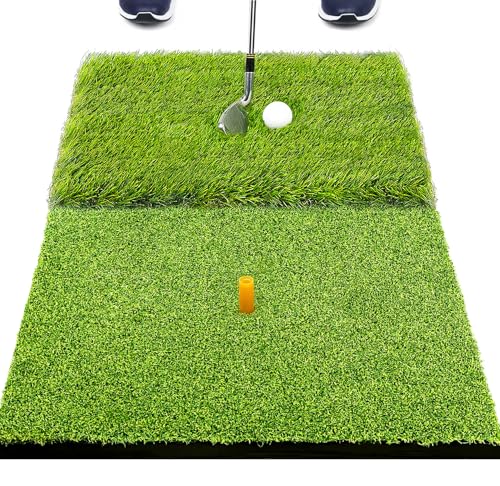
Publisher-assigned rating: Callaway FT Launch Zone Golf Hitting Mat with Rubber Backing Golf Putting Mat: 9.3/10 — manually assigned by Elias, the publisher, as the editorial rating of the first-ranked listing on this comparison (publisher_assigned). It is a subjective editorial judgment, not the output of the Amazon-review formula, not an Amazon customer rating and not a physical test result. The value sits between 9.1 and 9.4 and is stepped from the listing's unchanged formula score, as described in our methodology. The shortlist and its order, the Amazon review counts, customer averages and underlying calculated scores are unchanged; cards, summaries and table use this same displayed rating.